
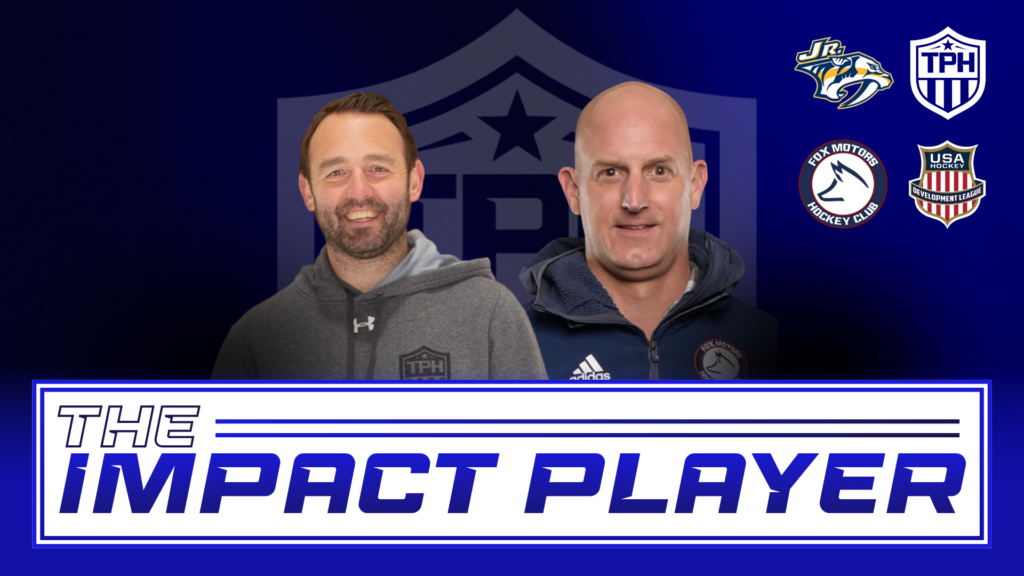
The Impact Player Podcast: USA Hockey Development League (DL) Insight from Fox Motors & Jr. Preds
Two DL club leaders walk through training schedules, recruiting, academics, and the one-game-a-day model as USA Hockey's new Development League takes shape.
The latest episode of the Impact Player Podcast puts two coaches building USA Hockey Development League (DL) programs in the same room to explain what the new league will look like day to day. Host Francis Anzalone, TPH Academy Chief of Operations and Development, sits down with Mike Berra, head coach of the Nashville Jr. Predators 15U DL team, and Mike "Slobo" Slobodnik, owner of Fox Motors Hockey Club and TPH Grand Rapids partner. This episode picks up where our previous DL episode with Jordan Pietrus and Ed Gingher left off, moving from how clubs earned their place in the league to how it will actually work for players and families in Tennessee and Western Michigan.
What is the USA Hockey Development League?
The DL is USA Hockey's new league for full-season 15U and 17U boys teams, and it begins play in the 2027–28 season. As we covered in USA Hockey Development League: A New Pathway for Student-Athletes, selected organizations may field up to five teams: 15U and 17U in the DL, plus 13O, 14U, and 18U at the Tier I level. The league works alongside the existing Tier I structure to prepare players for the USHL and NAHL, with multiple entry and exit points for players who develop at different rates.
USA Hockey invited 29 organizations for the inaugural season, and both of this episode's guests lead clubs on that list. Our DL teams and locations guide shows Michigan with the most invited clubs of any state, with Fox Motors joining Compuware, HB Hockey Club, and Little Caesars, while the Nashville Jr. Predators are Tennessee's DL club.
Keeping top talent closer to home
Francis opens with a question many families in both regions have lived with: does a strong DL club mean top players no longer have to leave home to find the right development opportunity? Slobo doesn't call that problem solved. He points out that player development keeps evolving and that a club has to keep rethinking how it develops players. What he does see is a strong foundation in Michigan, where the hockey culture and the national success of its teams helped four clubs earn DL spots. Fox Motors currently has four players in the USA Hockey National Team Development Program.
Fewer games, more development
The DL's schedule is one of the biggest changes families will notice. As outlined in The DL and USHL Relationship: Understanding the Pathway, DL teams will average at least three on-ice practices and two off-ice training sessions per week, alongside 40 to 55 games. Games are played one per day with 20-minute periods, and Slobo contrasts that with the five or six games in 72 hours that young players have often faced at showcases. He acknowledges the travel challenge of fitting a full season into that format, but he's clear that the model is healthier for the player. Francis, drawing on his scouting days, adds the evaluator's view of what a packed weekend does to the quality of play by Sunday.
Both coaches also talk through balancing games, practice, performance, and recovery, and how they're talking with parents who are used to a much heavier game schedule. For more on that shift, read USA Hockey DL Schedules: What Families Can Expect.
A day in the life of a DL student-athlete at TPH Academy
Berra gives the most concrete picture of the episode when he walks through a 17U day in Nashville. Players arrive at TPH Academy Nashville at about 9 a.m. and stay through roughly noon for academics. They head to the rink for a dynamic warmup, a skills session, and team video, then spend about an hour in team practice. They're in the gym around 3 p.m. and out the door by 4.
Berra expects the 17U team to run very close to a full academy model because of its practice times and skill skates. The 15U group will have more schedule flexibility, with ice from about 3 to 5 p.m. and the gym from about 5:15 to 6:15 p.m. Both coaches also describe how they structure on-ice practice and video review so the added training time has a purpose.
Academics stay central
For Slobo, development in the DL has to include the classroom. He describes the value of having a TPH classroom on site at TPH Academy Grand Rapids, with instructors who guide students and help when they need it rather than leaving schoolwork entirely to the student at home. He gives a simple example of accountability: if a player falls behind in math, that might be a day he doesn't go on the ice. The goal, in his words, is helping kids grow into well-rounded young men, not just good hockey players.
Berra adds a practical advantage for players with junior hockey in their future. Players on 17U DL teams are eligible for USHL and NAHL call-ups, and TPH Academy Online Powered by Subject is the Primary High School Academic Provider of the United States Hockey League (USHL). A DL player who gets called up during the season can keep working on the same academic platform. "They're not going to miss a beat," Berra says. Clubs can see how TPH supports a full DL roster, on-site or online, in USA Hockey Development League: Supporting Your Team Beyond the Ice.
The 17U question
The 15U level is easier to picture, and both guests agree with Pietrus and Gingher that the 17U level still carries some unknowns. Berra's approach is to take the players who are ready to compete at what he expects will be a very high level. He talks about making sure players arrive on time, meaning a player who isn't ready for 17U yet may be better served by a different step, since players develop at different rates. The episode also covers how both clubs think about tryouts, depth charts, local players, out-of-state recruiting, and development at the 13U and 14U levels.
Why NJP and Fox Motors
The closing segment brings it back to people. Berra describes a Jr. Predators staff, from skill coaches to head coaches and assistants, focused on one thing: the player. Slobo credits a lesson from his parents: where you'll be in 10 years comes down to "the books you read and the people you surround yourself with." For families sending a son away from home, he wants Fox Motors to offer a safe, healthy environment where players grow as people as well as players. He says nothing makes him happier than hearing National Team Development Program coaches say Fox Motors players are good kids.
In this episode
- 00:00 Introduction
- 01:15 Player retention and development in regional hockey
- 04:16 Structuring on-ice practice and video review
- 07:38 Staffing models and recruiting trends in the DL
- 10:14 Depth charts, local players, and out-of-state recruitment
- 12:28 Why Michigan is a powerhouse for DL clubs
- 15:50 Managing player pressure and game-to-practice ratios
- 22:52 Navigating development options at the 17U level
- 26:44 A day in the life of an NJP and Fox Motors student-athlete
- 31:08 Benefits of the one-game-per-day model for coaches and players
- 36:30 Development strategy for 13U and 14U age groups
- 41:45 Why NJP and Fox Motors?
Frequently asked questions
When does the USA Hockey Development League start? The DL begins play in the 2027–28 season with full-season 15U and 17U boys teams.
How many games and practices will USA Hockey DL teams have? DL teams will play 40 to 55 games, primarily against other DL teams, and average at least three on-ice practices and two off-ice training sessions per week. As discussed in this episode, teams play one game a day with 20-minute periods.
Which Michigan and Tennessee clubs were invited to the DL? Fox Motors, Compuware, HB Hockey Club, and Little Caesars were invited from Michigan, and the Nashville Jr. Predators were invited from Tennessee. See all 29 clubs in our DL teams and locations guide.
What does a school day look like for a DL player at TPH Academy? In Nashville, 17U players are expected to be at the Academy for academics from about 9 a.m. to noon, then move to skills, video, team practice, and the gym, finishing around 4 p.m. The 15U schedule offers more flexibility, with ice and gym time later in the afternoon.
How do DL players stay on track academically if they're called up to junior hockey? TPH Academy Online Powered by Subject is the Primary High School Academic Provider of the USHL, so a student-athlete called up during the season can keep working on the same academic platform, with NCAA-approved coursework, eligibility support, and live tutoring.
Will the DL cost families more? Pietrus breaks down how the changes may affect costs in USA Hockey Development League: Is it going to cost families more?
Watch the full episode
The full 45-minute conversation is streaming now. Watch The Impact Player Podcast: USA Hockey Development League (DL) Insight from Fox Motors & Jr. Preds on YouTube and subscribe for more conversations on player development, academics, and the pathways available to aspiring-elite student-athletes. You can find every DL guide and episode recap in the TPH Academy Resource Center.
About TPH Academy
TPH Academy is an international, academy-style environment where dedicated student-athletes study, train, and play at their highest potential. TPH Academy’s core purpose is to advance — in and beyond the game — the next generation of impact players. Through a flexible, accredited academic model, on-site academic support, individualized planning, world-class coaching, and sport-specific training, TPH Academy equips student-athletes with the structure and support to pursue excellence without compromise. Learn more in the TPH Academy Impact Report.